

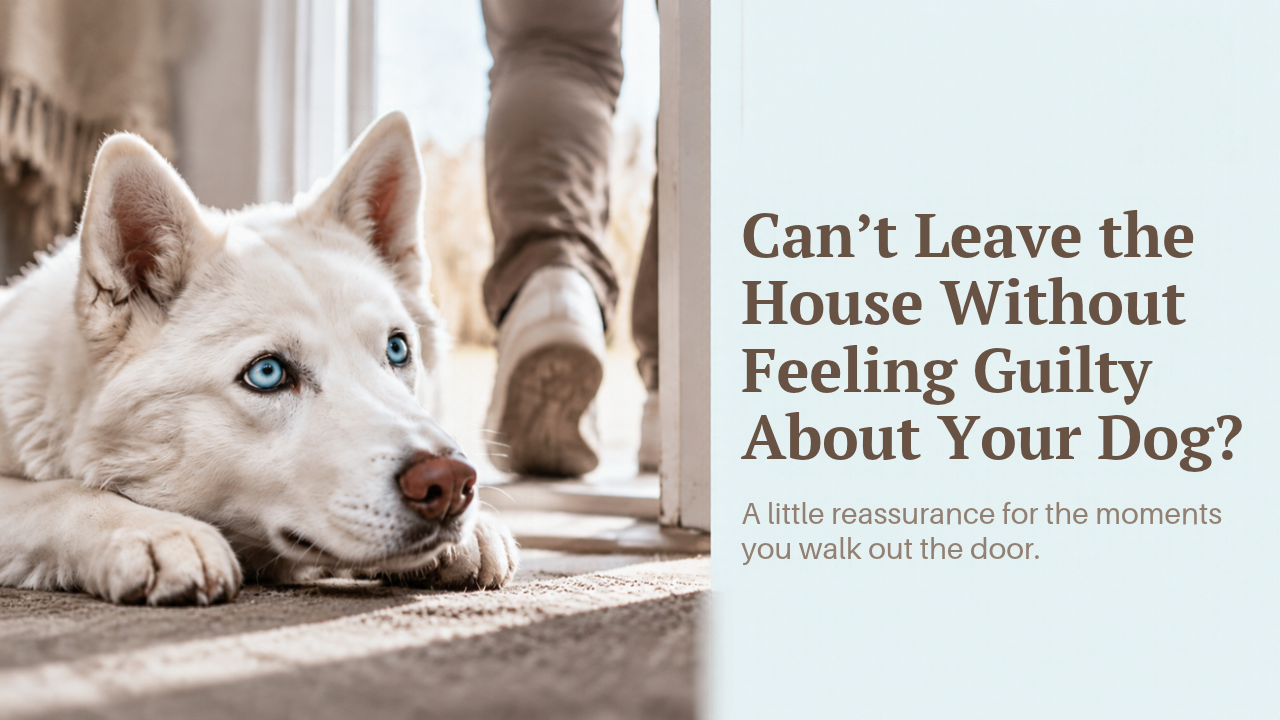
You’ve picked up your keys. Your shoes are on. You’re already running a few minutes late.
Then you look down.
There’s your dog, watching you from the hallway, and suddenly popping out for lunch feels like a personal betrayal.
Perhaps you give them another cuddle. Perhaps you explain, for the third time, that you won’t be long. Or perhaps you cancel your plans because staying home feels easier than worrying.
If you’re feeling guilty about leaving your dog, you don’t need another lecture about being a responsible owner. You need a sensible way to work out whether your dog is struggling, what you can do to help, and when you can stop giving yourself such a hard time.
There are two separate questions here: “Do I feel bad about leaving?” and “Is my dog distressed when I leave?”
They deserve different answers.
Some dogs can rest comfortably during an appropriate period alone. Others find separation difficult and need a carefully paced approach, sometimes with professional support. Looking at what your dog actually does is more useful than relying on either guilt or blanket reassurance.
Let’s work through it without blame, unrealistic promises or the idea that loving your dog means never leaving the house.
1. Separate Your Guilty Feelings From Your Dog’s Actual Experience
The difficult thing about guilt is that it can feel like evidence.
You feel awful as you close the door, so you assume your dog must feel awful too.
But your feelings don’t tell you exactly what happens once you’ve left. Your dog’s behaviour provides the more useful clues. The RSPCA recommends occasionally recording dogs during time alone because some signs of distress are otherwise easy to miss.
Imagine two different situations.
In the first, an owner spends an entire coffee break worrying. A recording shows their dog briefly looking towards the door, wandering to their bed and resting comfortably.
In the second, an owner assumes everything is fine because there’s no barking and no damage. A recording shows repeated pacing and panting instead.
These are illustrative examples, but they show why the same advice won’t suit every household. Quiet doesn’t automatically mean comfortable, and a worried owner doesn’t automatically mean a distressed dog. Pacing, trembling and other less obvious behaviours can matter too.
Try a facts-versus-fears check
Take a piece of paper and make two columns.
In the first, write what you’re worried about:
- “My dog thinks I’ve abandoned them.”
- “They’ll be miserable the whole time.”
- “A good owner would stay at home.”
In the second, write what you actually know:
- How long you’ll be away.
- Whether their care needs have been met.
- What you’ve observed during previous absences.
- Whether someone can help if needed.
The point isn’t to talk yourself out of a genuine problem. It’s to identify which worries need practical action and which are assumptions.
My view is that “Have I made a suitable plan for my dog?” is a fairer question than “Do I feel guilty enough to prove I care?”
One gives you something useful to do. The other has no obvious finishing line.
2. Find Out Whether Your Dog Is Comfortable Home Alone
Before buying another toy or searching for another training tip, find out what happens after you leave.
A safely positioned recording device can help you notice behaviour you wouldn’t otherwise see. Keep it out of reach, including any cables, and review the footage for patterns rather than treating a single moment as a diagnosis. The RSPCA specifically recommends video observation to help identify hidden signs of separation-related distress.
Look beyond whether the sofa survives.
Signs that deserve attention
The RSPCA lists possible separation-related behaviours including:
- Barking, howling or whining.
- Destructive behaviour, particularly around exits.
- Toileting indoors.
- Pacing or other repetitive behaviour.
- Trembling, panting or excessive salivation.
- Anxiety before departure.
- Not eating food or engaging with food toys during an absence.
- Self-injury.rspca
These behaviours need context. A damaged cushion or an indoor accident is not, by itself, a separation-anxiety diagnosis. Health issues can also contribute to changes in behaviour, which is one reason veterinary advice matters.
Keep a small observation diary
You don’t need a complicated spreadsheet. A few notes can give you something concrete to discuss with your vet or behaviour professional.
| What to record | Example |
|---|---|
| What happened before departure | Toilet break, gentle walk, time to settle |
| Planned absence | Brief local errand |
| Behaviour after departure | Resting, watching the door, pacing or vocalising |
| Response to food | Ate normally, ignored it or stopped eating |
| Relevant context | Visitors earlier, unusual noises or a change in routine |
| Next step | Repeat an easier exercise, adjust care or seek advice |
Don’t deliberately extend an absence to find out how distressed your dog can become. If they are struggling, the aim is to make the situation easier and get appropriate support, not collect more dramatic footage. Gradual training should stay within what the dog can comfortably manage.
3. Make Your Leaving Routine Comfortable, Not Complicated
When you’re feeling guilty about leaving your dog, it’s tempting to turn every departure into a major production.
An extra-long walk. Several treats. Three different toys. A lengthy goodbye speech delivered from the doorway.
A more useful starting point is to cover the essentials consistently.
The RSPCA recommends exercise and a toilet opportunity before an absence, suitable activities while the dog is alone, and steps to reduce disturbances where necessary. It also suggests returning from a walk around half an hour before leaving, giving the dog time to settle.
Meet their needs before you go
Think about:
- Have they had a suitable opportunity to exercise?
- Have they been able to go to the toilet?
- Is fresh water available?
- Is their resting space safe and comfortable?
- Are their feeding and any medical needs covered?
- Is the planned absence appropriate for this particular dog?
Choose activity that suits your dog’s age, health and usual routine. The aim is to prepare them for a comfortable rest, not exhaust them into being unable to react.
Reduce avoidable disturbances
If your dog repeatedly reacts to people passing the window, a quieter resting space or closing the curtains may help reduce those triggers. The RSPCA suggests both approaches as possible ways to limit disturbance and barking.
That doesn’t mean shutting a frightened dog somewhere unfamiliar immediately before leaving. Start with an environment they already find comfortable.
Treat enrichment as support, not proof of a solution
A suitable food toy can give a dog something enjoyable to do. Introduce it while you’re home first, so you can assess whether it is appropriate and safe for your dog.
But don’t assume a toy has solved the problem simply because you leave one behind. Some distressed dogs won’t eat or engage with food toys when alone.
Here’s the distinction I’d keep in mind: enrichment can make a suitable situation more enjoyable. It shouldn’t be used to explain away clear signs that the situation isn’t suitable yet.
For more everyday care and behaviour reading, explore the Dogs page on Love Your Furry Friend.
4. Build Comfortable Alone Time in Small, Manageable Steps
If your dog struggles when you leave, the answer isn’t to make the next absence longer and hope they get used to it.
The RSPCA recommends introducing alone time very gradually, increasing it according to the dog’s response and avoiding absences that become frightening or distressing.
That sounds simple. In practice, the important part is resisting the urge to rush.
Start with what your dog can already manage
For one dog, an easy starting point might be resting on their bed while you move around the room.
For another, it might be remaining comfortable while you briefly step out of sight.
For a dog showing significant distress, finding the right starting point may require professional guidance.
The principle is the same: begin with an experience the dog can manage, rather than the duration your schedule eventually requires. The RSPCA’s training guidance progresses from small movements away from the dog towards brief departures through a doorway.
Let behaviour decide the pace
A rigid plan can look reassuring:
“Five minutes today, ten tomorrow, half an hour by Friday.”
But a tidy timetable isn’t useful if your dog is distressed during it.
Instead, notice whether they remain comfortable as you make a small change. If they become anxious, make the next attempt easier rather than continuing to increase the challenge. Progress depends on their response, not an arbitrary deadline.
Picture a dog who can rest comfortably while their owner briefly steps into the hallway but begins pacing when the front door closes.
That isn’t a reason to jump straight to a trip to the supermarket. It’s information about where the current difficulty lies.
Don’t use punishment or “cry it out” as the plan
Barking, accidents or damage during separation may reflect distress, not spite. The RSPCA warns that punishment on the owner’s return can worsen separation-related problems.
If your dog becomes distressed, don’t turn waiting for silence into a rule that prolongs their distress. Make the situation safe, reduce the difficulty of future practice and seek help where needed.
And keep training separate from unavoidable commitments where you can. If your dog cannot currently cope with an absence you need to make, arrange suitable company rather than treating that absence as a training session. Dog sitters and other appropriate support can help protect welfare while you work on the longer-term problem.
5. Give Yourself a Practical Alternative to Guilt
Once your dog’s needs are covered and you have evidence about how they cope, you need a plan for yourself too.
Otherwise, it’s possible to keep moving the goalposts.
You check the camera. Your dog is resting. You check again. Still resting. Then you start worrying that perhaps they’re resting unhappily.
At that point, more checking may not answer the question you’re asking.
I’d use a simple departure check:
- Have I met my dog’s immediate needs?
- Is this absence within what they can currently manage?
- Have I arranged help if the answer is no?
- Do I know what I’ll do if their behaviour changes?
This isn’t a clinical test. It’s a practical way to make your decision based on care arrangements rather than how uncomfortable you feel at the door.
Match the response to the evidence
If you’re feeling guilty about leaving your dog but recordings consistently show comfortable behaviour during suitable absences, remind yourself of that evidence.
You don’t have to pretend you enjoy leaving them. You can miss your dog and still recognise that they are being appropriately cared for.
If recordings show distress, reassurance alone isn’t enough. Change the plan and get support.
That distinction matters because both extremes can be unhelpful: dismissing a struggling dog’s behaviour, or assuming every ordinary absence is a failure of love.
Build a realistic support network
Sometimes the immediate solution is practical rather than emotional.
You might need:
- A trusted friend who can stay with your dog.
- A sitter for appointments or social plans.
- A walker to meet exercise and toilet needs where the dog is otherwise comfortable alone.
- A different care arrangement during a particularly demanding working week.
Choose support that addresses the actual difficulty. If your dog becomes distressed almost immediately, a walk several hours later won’t cover the earlier period of distress. The RSPCA notes that some dogs become anxious within minutes, or even before their owner leaves.
Needing help doesn’t mean you’ve failed. It means the care plan has to fit the dog and the day you’re dealing with.
6. Know When Your Dog Needs More Than General Advice
There comes a point when another article, toy or social-media tip isn’t the right next step.
Speak to your vet if your dog shows repeated distress when left alone, if the behaviour appears suddenly, or if you notice other changes in their wellbeing. Underlying health issues can cause or contribute to separation-related behaviour, and your vet can advise on assessment and referral.
Don’t try to manage self-injury or dangerous escape attempts through an online checklist. Make safety the immediate priority and seek veterinary advice promptly.
Take sudden changes seriously
Perhaps your dog previously rested during short absences but has recently started pacing, vocalising or toileting indoors.
It’s tempting to label the change immediately: boredom, jealousy, stubbornness or separation anxiety.
A better starting point is to describe what changed, when it began and what else you’ve noticed. Bring any useful recordings and your observation notes to the vet. Behaviour changes can have several possible contributors, including illness or injury.
Ask for appropriately qualified support
Where separation-related difficulties persist, the RSPCA recommends speaking to a vet, who may refer you to a clinical animal behaviourist.
An individual assessment can help distinguish what is happening in your household and shape a suitable plan.
General information still has a role. It can help you notice patterns, ask better questions and understand why a gradual approach matters. But it cannot examine your dog, assess their medical needs or guarantee a timetable.
The same boundary applies to online quizzes: they can be a starting point for thinking about behaviour, not a diagnosis or a substitute for veterinary care.
Conclusion: You Can Care Deeply Without Cancelling Your Life
Loving your dog doesn’t mean you have to judge every outing by how guilty you feel.
The more useful measure is whether their needs are met, whether the absence suits their current ability to cope, and whether you’re responding when the evidence shows they need help.
If your dog is comfortable, you can work on giving yourself permission to trust that.
If your dog is struggling, you can take practical steps: arrange company, make alone-time practice easier and speak to your vet when needed. You don’t have to solve everything through trial and error.
And if you’re feeling guilty about leaving your dog because you’re not sure where to begin, start by getting clearer about what happens before, during and after you leave.
The My Dog Plan Quiz is a gentle next step for exploring your dog’s behaviour and the concerns you’d most like to address. It isn’t a diagnosis or a replacement for professional advice, but it gives you somewhere to start.
Take the My Dog Plan Quiz and explore a plan based on your answers.
Frequently Asked Questions
1. Is it normal to feel guilty when I leave my dog?
Guilt is the central concern addressed by the supplied article, which describes it as common among owners. But the feeling itself doesn’t establish whether your dog is distressed.
Use it as a prompt to review your arrangements rather than a verdict on your ownership. Check that your dog’s needs are covered and observe how they cope during suitable absences. Video can help reveal behaviour you would otherwise miss.
2. How long can I leave my dog alone?
The RSPCA advises leaving dogs alone for no longer than four hours, and puppies for much less. That is guidance, not a target every dog should be expected to reach.
Your dog may need much shorter absences because of their age, health, toilet needs or ability to cope. A dog who becomes distressed within minutes needs a different arrangement, even when the planned outing is well below four hours.
3. Does crying when I leave mean my dog has separation anxiety?
Crying, whining and howling can be signs of separation-related distress, but vocalising alone doesn’t establish a diagnosis. Look at the context and other behaviours, and speak to your vet if you’re concerned.
Useful information includes when the crying begins, what your dog does alongside it, and whether the behaviour occurs specifically around separation.
4. Should I get another dog to keep mine company?
Don’t make that decision on the assumption that another dog will solve the problem. Separation-related difficulties need an individual assessment, and some dogs struggle with the absence of a particular person rather than simply needing an occupied house.
Before making a major change to your household, discuss your current dog’s behaviour with your vet and, where appropriate, a clinical animal behaviourist. A second dog should be a considered commitment in its own right, not an untested treatment plan.
5. Can I comfort my dog if they become upset?
The priority is to respond calmly and safely, not punish your dog or insist they remain distressed to complete an exercise. The RSPCA recommends avoiding frightening alone-time experiences and reducing the difficulty when a dog struggles.
If upset happens repeatedly, don’t focus only on what to do afterwards. Adjust the next departure, arrange suitable support and seek professional advice so the same distress isn’t repeatedly built into your routine.

Discussion 0 comments
Share your thoughts — every perspective adds value.